




In the gleaming offices of Singapore’s business district, a senior executive sat across from her coach, stuck. She’d come seeking clarity about finding her voice as a female CEO in the male-dominated automotive industry. The usual coaching questions weren’t breaking through. Then her coach handed her something unexpected: a camera.
“Take 30 minutes,” he said. “Walk around and photograph whatever speaks to your feelings about this challenge. Don’t think too much. Just shoot.”
When she returned and began viewing her images on a large monitor, one photograph stopped her cold. She’d been drawn to light streaming through a circular opening—a metaphor for hope, she thought. But now, reviewing the image with her coach, she noticed something else: an exit sign in the corner of the frame.
The session’s entire direction pivoted in that moment. The real question wasn’t about finding her voice. It was whether she should stay in a toxic relationship with the company’s founder at all.
This breakthrough moment exemplifies the surprising power of what researcher, coach and consultant Darryl Chen calls “photo-coaching”—a methodology he developed and tested that’s challenging conventional approaches to leadership development in an age increasingly dominated by AI-driven solutions and efficiency metrics.
When Words Fail

Chen’s research, conducted as part of the Executive Master in Change program at INSEAD, addresses a fundamental limitation in how we typically approach personal and professional development: our reliance on verbal communication and conscious thought.
“Many coaching methods remain at a surface level without an exploration of unconscious material,” Chen writes. In other words, we’re trying to solve deep-seated challenges with the same thinking that created them.
The timing of this research feels particularly relevant today. As organizations rush to implement AI coaching tools and automated development programs—solutions that promise scale and efficiency—Chen’s work suggests we might be overlooking something essential: the messy, non-linear, deeply human process of self-discovery that can’t be reduced to an algorithm.
The hypothesis was deceptively simple:
What if we gave people cameras and asked them to photograph their feelings about a leadership challenge they were facing? Could the act of image-making—and the images themselves—unlock insights that traditional coaching conversations miss?
Over nine coaching sessions with real executives facing genuine dilemmas, Chen discovered something unexpected. The camera didn’t just help people express themselves. It transformed the entire coaching process in ways that challenged prevailing theories about how personal transformation actually works.
The Camera Takes the Blame
One of Chen’s most intriguing findings centers on how participants related to the camera itself—not as a neutral tool, but as what psychoanalysts call a “transitional object.”
Think of a child’s security blanket or favorite teddy bear. These objects exist in a special psychological space: they’re separate from the child, yet they represent something deeply personal. The camera, Chen discovered, functions similarly for adults engaged in difficult self-examination.
“The strangeness of the camera made me feel safe to explore,” one participant told Chen. Another noted: “If the picture turns out not nice, it could be the lighting, could be the camera... that’s not my profession, right?”
The camera, in essence, took the blame. It absorbed participants’ performance anxiety and fear of judgment in a way that other creative methods—like drawing or sculpting—couldn’t. When asked to contrast photography with drawing, every participant favored the camera, citing phrases like “I’m not artistically inclined” or “My hand can’t do what I see in my head.”
But the camera offered something more profound than just reduced anxiety. Because it belonged to the coach—because it was external, unfamiliar, and specifically designated for this task—it created what one participant described as “a fresh pair of glasses to look at things differently.”
This externality proved crucial. In our smartphone age, where our devices feel like extensions of ourselves, the dedicated camera represented something apart from daily routine. “A camera is very distinct and purposeful for the task,” one participant explained. “You don’t have to deal with any other thing.”
The Transformative Power of Not Thinking
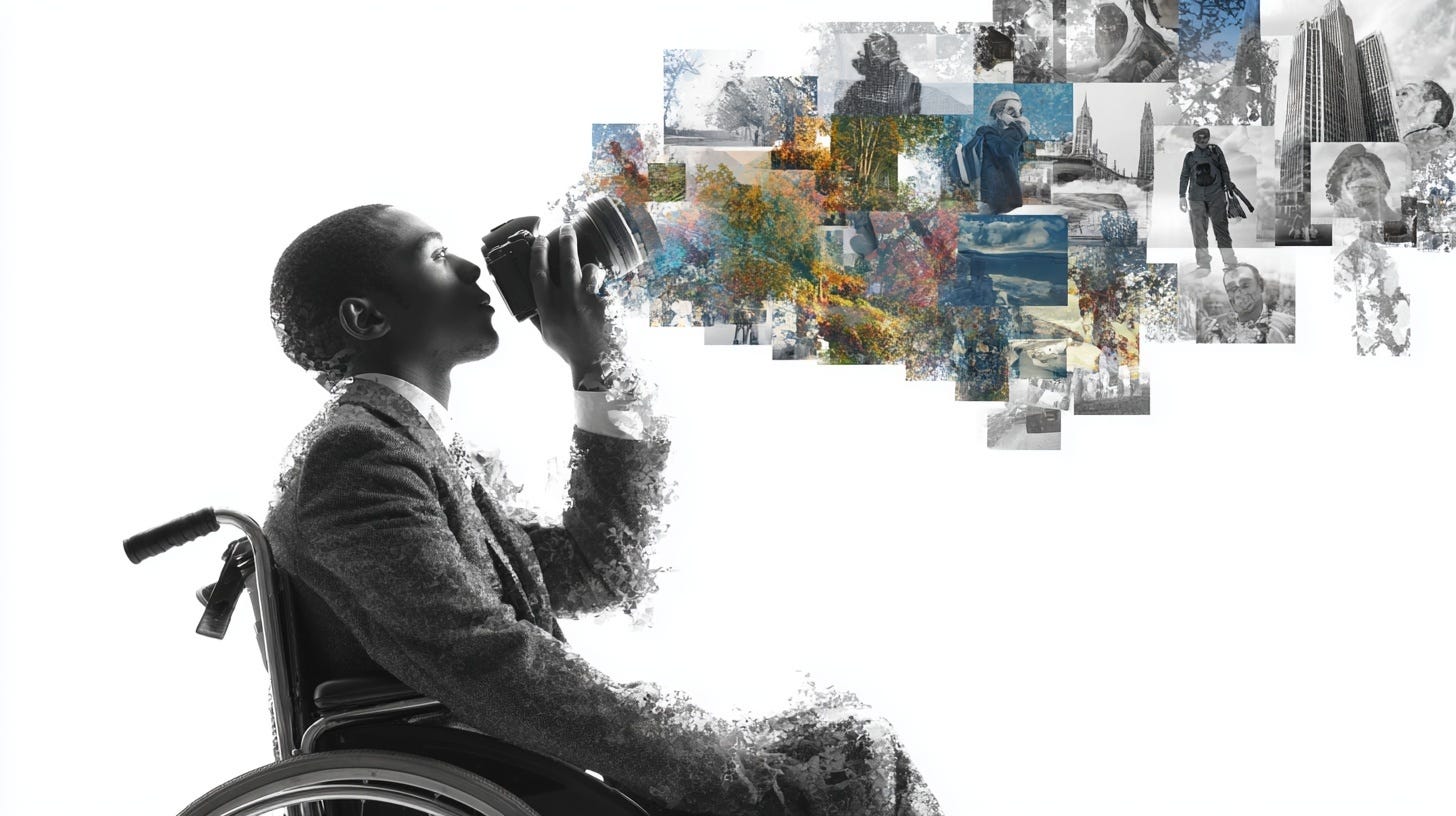
The second major finding challenges our culture’s obsession with conscious analysis and rational problem-solving.
Chen designed the photo-taking exercise with very specific instructions: capture images that express your feelings about your challenge, don’t look at the pictures you’re taking, don’t try to make sense of them, and resist analyzing what they might mean. Just shoot what draws you.
This deliberate suppression of conscious reflection produced remarkable results. Participants described entering states that sound remarkably like mindfulness or flow:
“I felt focused. I felt engaged. I felt interested,” said one. Another reported being “more aware of my own judgments... all these things that pop up, I acknowledge them, I’m aware of them but I still follow the flow.”
The neuroscience here is fascinating. When we’re consciously trying to solve a problem, we activate the same neural pathways and mental models we always use. But by photographing intuitively—following gut feelings and emotional responses without verbal analysis—participants seemed to access different forms of knowing.
“At the start it was more like a feeling kinda thing,” one participant reflected. “I guess I know that it’s really just being playful, having an open mind to explore how I feel.”
This playfulness, Chen argues, creates what psychoanalyst Donald Winnicott called a “transitional space”—a psychological zone between inner reality and the external world where creativity and discovery become possible.
The results speak for themselves. Of the nine participants, nearly all emerged with insights dramatically different from their initial presenting issues. An executive who came asking how to balance his full-time job with a startup venture left realizing his real challenge was about blurred boundaries between friendship and business. An entrepreneur seeking career direction discovered her dilemma stemmed from childhood fears about financial security.
What the Images Revealed
Perhaps the most powerful moment in photo-coaching comes when participants return from their image-making expedition and begin viewing what they’ve captured.
Chen deliberately designed this process with careful attention to the physical setup. Images were projected on a large monitor, but the coach positioned himself facing primarily toward the client, keeping the monitor in peripheral vision. The client controlled which images to view, navigating through them on a tablet.
This arrangement matters more than it might seem. In PhotoTherapy—a related but distinct practice—therapists are warned to “keep the focus off the client and on the photo” to avoid making assumptions. But Chen’s research suggests that in coaching, the opposite approach yields better results. By maintaining primary focus on the client while using images as a catalyst, coaches can attend to something crucial: their own emotional and somatic responses to both the client and the images.
This is where Chen’s framework becomes particularly sophisticated, drawing on psychoanalytic concepts that might seem esoteric but prove remarkably practical.
In one session, a participant was exploring photos related to balancing work commitments. As they discussed three images of disconnected objects, Chen felt “a tremendous sense of guilt creeping into me.” Rather than dismissing this feeling, he shared it with his client.
The client’s response was immediate: “Yes, guilt.” The entire session pivoted to explore guilt around working with friends, boundaries, and unspoken expectations—material that hadn’t surfaced in the initial framing of the challenge.
In another session, Chen experienced a physical sensation of wanting to run out of the room—strange for him, as this wasn’t typical. Using this somatic reaction as data, he asked the client what they might be “avoiding.” After a long silence, the client admitted he hadn’t brought a real challenge but had made something up to help with the research. This breakthrough allowed them to explore the client’s actual issue: defensiveness about asking for feedback.
These examples illustrate what psychoanalysts call “projective identification”—the unconscious process by which one person’s feelings get transferred to another. Rather than seeing this as contamination of the coaching process, Chen argues it’s essential data that skilled coaches should learn to recognize and use.
Beyond the Transitional Space

Chen’s most significant theoretical contribution challenges even his own initial hypothesis.
He began with the idea that photo-coaching creates what Winnicott called a “transitional space”—a safe zone for exploration and play. This proved true. But something more was happening.
By making himself fully available—attending not just to words but to his own emotional responses, bodily sensations, and intuitive reactions—Chen found he was creating what psychoanalyst Christopher Bollas calls a “transformational object.”
The distinction is subtle but profound. A transitional space is something you create with someone. A transformational object is something you become—a facilitating presence that enables another person’s development and growth.
“You created a safe space for me to open up,” one participant reflected. Another noted: “You have a very nice presence, you are non-judgmental, you ask probing but gentle questions.”
But participants struggled to articulate exactly what the coach did that was helpful. It wasn’t just the questions asked or techniques employed. It was a quality of presence—what Bollas describes as “countertransference readiness,” the willingness to be emotionally available and responsive to whatever emerges.
This challenges the trend toward standardized, scalable coaching interventions. If the coach’s subjective, embodied presence is essential to transformation, then automation and artificial intelligence—no matter how sophisticated—may be fundamentally limited in their ability to facilitate deep personal change.
The Framework for Practice
For coaching professionals, Chen offers a practical framework built on these insights.
The photo-coaching process unfolds in two distinct phases, each creating different psychological conditions:
Phase 1: Image-Making The camera functions as a transitional object, taking on participants’ projections and performance anxiety. The coach provides clear task boundaries (what to photograph, how long, where to go) while explicitly instructing participants not to analyze or make sense of their images. This creates conditions for intuitive, non-verbal knowing to emerge.
Phase 2: The Coaching Conversation Images become vessels for meaning-making through what psychoanalysts call “introjective processes”—the unconscious adoption of meanings and insights. But critically, the coach must attend to multiple sources of data: the client’s verbal reflections, the images themselves, and the coach’s own emotional and somatic responses.
It’s this third source—the coach’s subjective experience—that conventional training often neglects or even discourages. Yet Chen’s research suggests it’s essential. By noticing feelings of guilt, impulses to flee, physical tension, or intuitive hunches, coaches access crucial information about unconscious dynamics in the room.
The framework rests on what philosophers call “intersubjectivity”—the idea that meaning emerges not just within individuals but between them, in the space of relationship. The coach doesn’t maintain objective neutrality but rather becomes a participant in a shared process of discovery, using their own responses as legitimate data.
Implications for an AI Age
As organizations increasingly turn to technology-driven solutions for leadership development—AI coaching chatbots, automated feedback systems, algorithm-driven assessments—Chen’s research offers a counterpoint worth considering.
The effectiveness of photo-coaching, he argues, hinges precisely on elements that resist automation: embodied presence, emotional attunement, the capacity to work with ambiguity and not-knowing, and the willingness to be personally affected by another’s experience.
This doesn’t mean technology has no role. The methodology itself uses basic digital tools—a point-and-shoot camera, a tablet, a display monitor. But these tools serve human processes of meaning-making rather than replacing them.
More broadly, Chen’s work suggests that as work becomes more automated and efficiency-driven, we may need development approaches that go deeper, not shallower.
Quick fixes and surface-level interventions might produce compliance or temporary behavior change. But transformation—the kind that enables people to navigate complexity, tolerate uncertainty, and access their full creative capacity—may require exactly the kind of messy, non-linear, deeply relational process that photo-coaching enables.
A Different Kind of Seeing
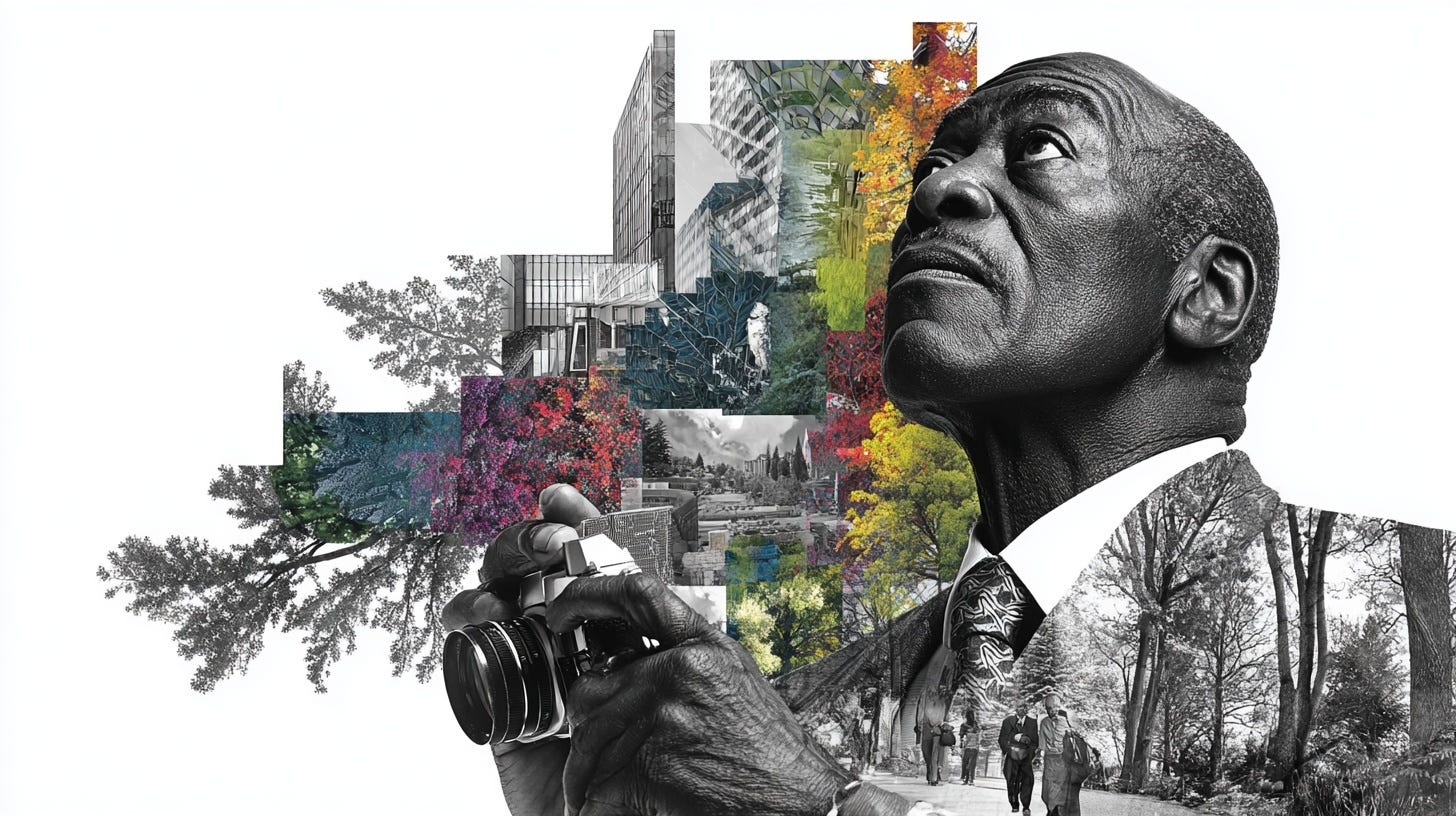
Chen’s study opens with a telling anecdote. Acquaintances looking through his vacation photos commented: “You must be a people person! Your photos are mostly of people and it captures their emotions.”
This observation sparked the research: What else can photography reveal if we allow ourselves to dig deeper?
The answer, it turns out, is quite a lot. Not because cameras are magic or because images contain objective truth, but because the act of making and viewing photographs can create conditions for a different kind of seeing—one that bypasses our verbal, analytical defenses and accesses material we otherwise keep hidden, even from ourselves.
In executive coaching circles, there’s growing recognition that leadership development isn’t just about acquiring skills or changing behaviors. It’s about transformation—shifts in how people see themselves, understand their relationships, and navigate complexity.
Photo-coaching suggests one path toward that transformation, rooted not in newer technology or more sophisticated assessment tools, but in something paradoxically simpler: the willingness to play, the courage to not-know, and the radical act of paying attention to what’s actually there rather than what we think should be.
As one participant reflected at the end of their session: “The pictures are a tool, but to still have you let me engage with them in a very freestyle but non-judgmental way... it’s a tool and it cannot replace your role.”
In our rush toward automated solutions and artificial intelligence, that might be the most important lesson of all: some forms of human development can’t be outsourced to machines. They require the irreducible messiness of two people, a camera, and the willingness to see what emerges when we stop trying so hard to figure everything out.
Darryl Chen’s thesis, “Capturing the Unconscious: A Psychodynamic Lens on Using Photography in Coaching,” was submitted in June 2018 as part of the Executive Master in Change program at INSEAD.
References and Further Reading
Primary Source
Chen, D. (2018). Capturing the Unconscious: A Psychodynamic Lens on using Photography in Coaching. INSEAD Executive Master in Consulting and Coaching for Change, Wave 23, Singapore.
Key Theoretical Works Cited
On Transitional Objects and Psychoanalytic Theory:
Winnicott, D.W. (1971). Playing and Reality. New York: Basic Books.
Bollas, C. (1987). The Shadow of the Object: Psychoanalysis of the Unthought Known. New York: Columbia University Press.
Klein, M. (1946). Notes on Some Schizoid Mechanisms. The International Journal of Psycho-Analysis, 27, 99-110.
Bion, W. (1962). Learning from Experience. London: Karnac Books.
On Photography in Research and Therapy:
Weiser, J. (1999). PhotoTherapy Techniques (2nd ed.). Vancouver, Canada: Phototherapy Centre Press.
Collier, J., & Collier, M. (1986). Visual Anthropology - Photography as a Research Method (Revised and Expanded ed.). Albuquerque: University of New Mexico Press.
Harper, D. (2002). Talking About Pictures: A Case for Photo Elicitation. Visual Studies, 17, 13-26.
On Arts-Based Methods in Organizations:
Barry, D., & Meisiek, S. (2010). Seeing More and Seeing Differently: Sensemaking, Mindfulness and the Workarts. Organization Studies, 31(11), 1505-1530.
Warren, S. (2017). Photography in qualitative organizational research: conceptual, analytical and ethical issues in photo-elicitation inspired methods. In C. Cassell, A.L. Cunliffe, & G. Grandy (Eds.), The SAGE Handbook of Qualitative Business and Management Research Methods: Methods and Challenges. SAGE.
On Countertransference and Intersubjectivity:
Racker, H. (1968). Transference and Counter-transference. London: Karnac Books.
Finlay, L. (2005). “Reflexive Embodied Empathy”: A Phenomenology of Participant-Researcher Intersubjectivity. Indo-Pacific Journal of Phenomenology, 33(4), 271-292.
Related Reading on Visual Methods
Wang, C.C., & Burris, M.A. (1997). Photovoice: Concept, Methodology, and Use for Participatory Needs Assessment. Health Education & Behavior, 24(3), 369-387.
Rose, G. (2007). Visual Methodologies: An Introduction to the Interpretation of Visual Materials. London: Sage Publications.
Meyer, R.E., Höllerer, M.A., Jancsary, D., & van Leeuwen, T. (2013). The Visual Dimension in Organizing, Organization, and Organization Research: Core Ideas, Current Developments, and Promising Avenues. The Academy of Management Annals, 7(1), 489-555.
Schaverien, J. (2005). Arts, dreams and active imagination: A post-Jungian approach to transference and the image. The Journal of Analytical Psychology, 50(2), 127-153.
On Coaching and Organizational Development
Schein, E.H. (2013). The Role of Art and the Artist. Organizational Aesthetics, 2(1), 1-4.
Kets de Vries, M. (1991). On becoming a CEO: Transference and the addictiveness of power. In M. Kets de Vries (Ed.), Organizations on the couch: clinical perspectives on organizational behavior and change (pp. 120-139). San Francisco: Jossey-Bass.