



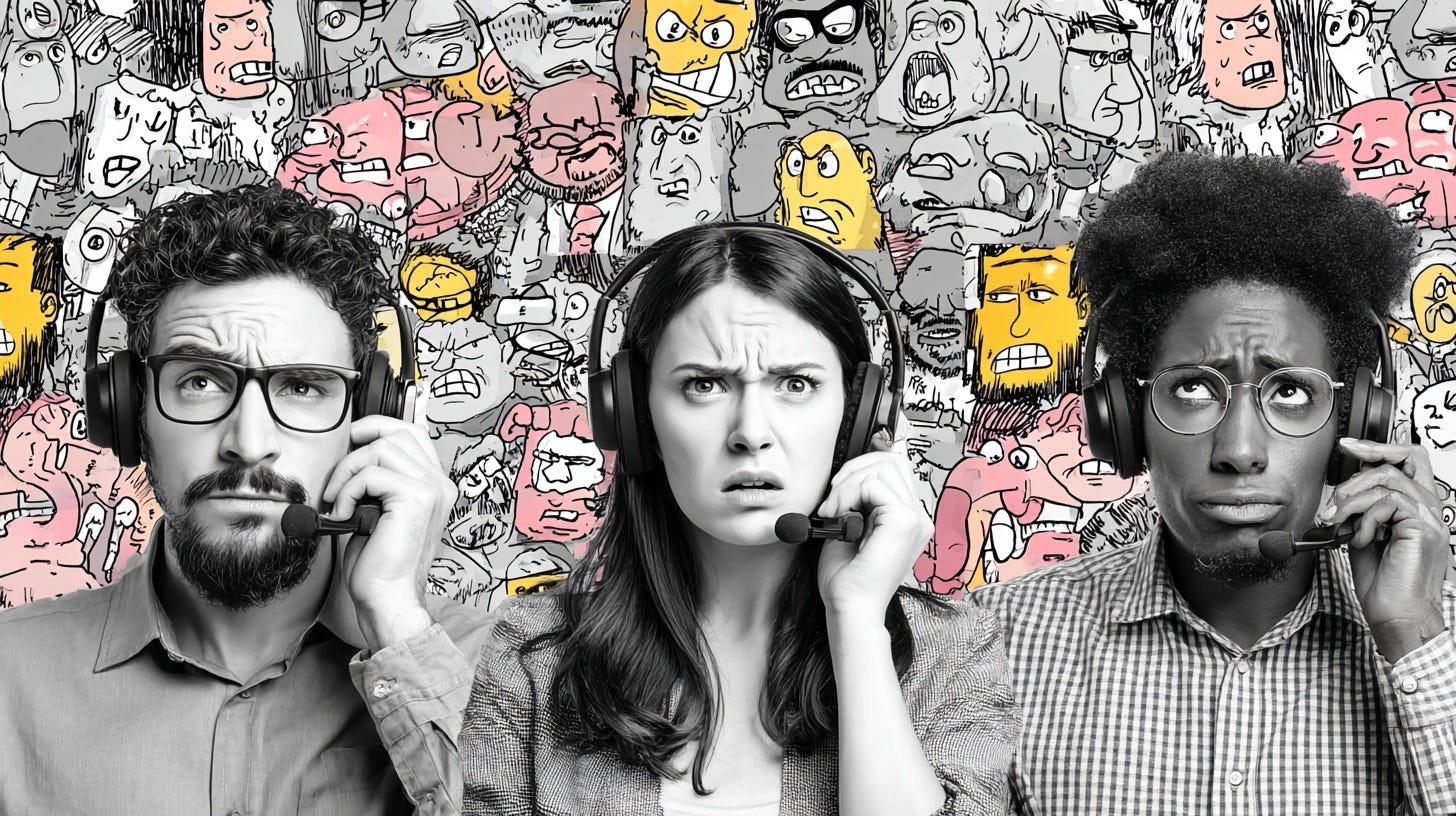
As AI chatbots proliferate and companies slash support budgets, the human psychology behind customer rage—and how to defuse it—has never been more critical.
It starts with a simple phone call. You’ve been overcharged, a product stopped working, or a promised refund never arrived. You dial customer service, expecting help. Instead, you’re transferred three times, asked to repeat your information twice, and eventually told the agent needs to “check with their supervisor.” By the time you hang up—problem unsolved—you’re furious.
Now imagine being on the other side of that call. You’re a customer service agent in Manila or Bangalore, headset on in a room buzzing with dozens of other voices. Your performance is measured by how quickly you close tickets, not whether customers feel heard. When someone screams at you for the third time today, you have no training in handling their emotions—only a script. You’re exhausted, considering calling in sick tomorrow just to recover.
This volatile dynamic—the collision of frustrated customers and overwhelmed agents—has become a defining feature of modern commerce. In 2025, as companies increasingly rely on AI chatbots for first-line support and route only the most complex, emotional cases to human agents, understanding the psychology of these fraught interactions isn’t just important. It’s urgent.
A groundbreaking study by INSEAD Executive Master in Change researcher Sudhir Sharma, who interviewed both customers and support agents about their most difficult interactions, reveals why customer service calls can go wrong—and what companies are fundamentally misunderstanding about quality support. The findings suggest that while businesses obsess over metrics like call resolution time and customer satisfaction scores, they’re missing the deeper psychological dynamics that determine whether an interaction succeeds or explodes.
The $11 Billion Problem
The stakes are staggering. In Singapore alone, businesses lose $11 billion annually due to poor customer service. Globally, the numbers are astronomical. According to research firm Gartner, 89% of companies now compete primarily on customer experience—yet most are failing at the most basic level: the human interaction.
“We can measure everything now,” says one customer service manager interviewed for the study. “Time to first response, resolution rate, utilization. But we can’t seem to measure whether our customers actually feel heard.”
The consequences extend beyond lost revenue. In extreme cases, customer grievances have turned violent. In 2018, a woman who believed YouTube was suppressing her videos opened fire at the company’s headquarters, wounding several people before taking her own life. In 2017, a passenger dragged from an overbooked United Airlines flight sparked international outrage, costing the company millions in settlements and brand damage.
These dramatic incidents represent the far end of a spectrum that includes millions of daily interactions where customers feel dismissed, agents feel attacked, and companies wonder why their satisfaction scores keep dropping despite investments in “customer-centric” policies.
The Listening Gap
When Sharma asked customers to describe their worst support experiences, a consistent theme emerged: they didn’t feel heard.
“I said I want to cancel their services because I’m so pissed off,” one customer recalled. “The agent said go ahead and you can cancel online—without asking why I’m thinking of canceling. This made me feel like they don’t care.”
Another described calling with multiple issues, getting one addressed, then watching the agent prepare to hang up without asking about the others. “I had to interrupt and remind them I called about three things.”
These aren’t edge cases. They represent a fundamental breakdown in what psychologists call “active listening”—the practice of not just hearing words, but understanding meaning and demonstrating that understanding back to the speaker.
The problem isn’t that agents can’t hear. It’s that they’re not trained—or empowered—to truly listen. Most receive extensive technical training but almost no instruction in emotional intelligence or managing their own feelings when confronted with an angry customer.
“I don’t know how to deal with an angry customer, other than just to say ‘please maintain the decorum’ of this discussion,” one agent admitted. “For any aggressive customer interaction, we add details in a document, but don’t know what happens next.”
The Factory Floor
To understand why this gap exists, consider the typical customer service environment. Multiple agents described their workplaces as resembling factory floors—dozens of voices speaking different languages, background noise constant, every word recorded and potentially reviewed in team meetings to “point out mistakes.”
Agents work from scripts, have limited autonomy to make decisions, and must frequently say “Let me check with my supervisor.” Their performance is judged primarily on quantitative metrics: how many cases they handle (called “utilization”), how fast they respond, and their resolution rate.
“Everything we say on the phone is being recorded,” one agent explained. “Sometimes they’re played back in the team meetings. Our supervisors make a decision, and then we’re the messengers who have to carry the bad news back to the customer.”
This creates what psychologists call a “hostile holding environment”—the opposite of the safe, supportive space needed for productive communication. Rather than feeling empowered to solve problems creatively, agents feel surveilled and constrained.
The emotional toll is severe. Agents described feeling “tense” when tickets remained open in their queue, “burned out” after dealing with hostile customers, and sometimes calling in sick just to recover from particularly stressful interactions. Industry research shows a direct correlation between frequency of angry customer encounters and agent burnout.
What Customers Really Want
Sharma’s research identified a hierarchy of customer needs that extends far beyond simply getting their problem fixed. While resolution matters, customers also want:
Empathy: Not just sympathy, but genuine understanding of their situation. When an agent puts themselves in the customer’s shoes and demonstrates that understanding through words and tone, customers feel valued.
Control: Customers want to feel they have some influence over the outcome. Being told “this can’t be done” without explanation or alternatives triggers feelings of powerlessness.
Transparency: Customers want to know what’s happening and why. Being put on hold without explanation or promised a callback that never comes violates trust.
Recognition: Customers want to feel their business matters. Being treated as “just another ticket” breeds resentment.
Honesty: Customers prefer difficult truths over convenient lies. “The agent outright said ‘this can’t be done,’” one customer recalled. “After I spoke with them for five minutes, they agreed that it’s a simple thing, and apologized for being negative earlier.”
Perhaps most surprisingly, customers don’t always need their problem solved immediately. What they can’t tolerate is feeling ignored, deceived, or dismissed.
The Quality Paradox
Here’s where it gets interesting: companies think they’re measuring quality, but they’re often measuring the wrong things.
Most organizations use Customer Satisfaction (CSAT) scores—typically a five-point scale from “very satisfied” to “very dissatisfied.” But Sharma’s research reveals critical flaws in how these scores are collected and interpreted.
First, companies often focus on “top box scores”—the percentage of customers rating service “very satisfied” or “satisfied.” This approach lumps together genuinely delighted customers with those who were merely adequate experiences. More importantly, it loses valuable data from the “neither satisfied nor dissatisfied” group and everyone below.
“These are usually considered as ‘Users being Not Happy Users’ even after we try to help them,” one agent explained. The company writes them off rather than investigating what went wrong.
Second, surveys are supposed to reach random customers, but agents admitted they often ask their “favorite clients” during calls if they would complete the survey, thus skewing results toward positive responses and missing feedback from genuinely unhappy customers.
Third, when companies do audit interactions for quality, they weight factors bizarrely. In one quality framework Sharma examined, attributes like “acknowledging the issue,” “reassurance,” “clear explanations,” and “communication style” received only 20% of the total quality score—categorized as “not critical.”
Meanwhile, 40% of the score came from “customer critical” factors like avoiding making customers repeat information and resolving issues quickly. Another 20% covered “compliance critical” items like authentication and protecting personally identifiable information.
While speed and legal compliance matter, this weighting ignores the emotional dimensions that determine whether customers feel satisfied or enraged. An agent can check all the boxes—resolve quickly, follow authentication protocols, document everything—and still leave a customer furious because they felt dismissed or condescended to.
The Psychology of the Space Between
What Sharma found most fascinating was exploring the psychological “space” that forms between customer and agent during an interaction—what psychodynamic theory calls a “holding environment.”
Imagine two strangers who’ve never met, will likely never meet again, and know nothing about each other’s backgrounds, stresses, or emotional needs. One is dealing with a problem—possibly the latest in a series of frustrations. The other is doing a job—possibly their thirtieth call of the day.
For this interaction to succeed, someone needs to create safety. The customer needs to feel they can express their frustration without being dismissed. The agent needs to feel they can acknowledge limitations without being abused. Both need to trust that the other is acting in good faith.
“Understanding customer wants and needs can help create positive customer experiences,” Sharma writes. But this understanding requires something most organizations don’t provide: training in emotional regulation, empathy, and the ability to understand that other people have different mental states, beliefs, and perspectives than our own.
When this holding environment collapses—when the customer feels unheard or the agent feels attacked—both parties activate defense mechanisms. Customers become aggressive: demanding supervisors, threatening legal action, using profanity, refusing to hang up. Agents become defensive: falling back on scripts, passing the buck, or simply shutting down emotionally.
“Some customers are very aggressive,” one agent said. “They’d want everything right away. Some customers start using bad swear words. Some customers have asked for our personal details like name, email ID, location, so that they can personally ‘see to it.’”
Reframing Complaints as Gifts
Perhaps Sharma’s most counterintuitive finding is his suggestion that companies completely reframe how they think about complaints.
“When we think about complaints, we think about conflict, things being unsatisfactory, unacceptable,” he writes. But what if complaints are actually opportunities—signals that a customer cares enough to give the company another chance?
“Customers that don’t complain might be the ones that are likely looking to take their business elsewhere,” Sharma notes. “A complaint is your opportunity to rise to the challenge, to not be remembered for what went wrong, but what you did to fix it.”
This perspective shift requires cultural change. Currently, when customers complain, agents often feel defensive. Organizations treat complaints as problems to be minimized rather than intelligence to be valued. Quality auditors mark down agents for generating complaints rather than praising them for surfacing issues.
But if companies truly believed complaints were gifts—rare opportunities to identify problems before customers simply leave—they would approach these interactions completely differently. They would train agents in how to welcome difficult feedback. They would reward employees who successfully convert angry customers into satisfied ones. They would analyze complaint patterns to fix systemic issues.
“Complaints are gold, not conflict,” Sharma argues. “You’re being offered the chance to make things better, to affect positive change.”
A Framework for Better Interactions
Based on his research, Sharma proposes a framework for handling difficult customer interactions that prioritizes psychology over productivity:
Listen without interrupting: Practice active listening. Let customers fully express themselves before responding. Write everything down so they don’t have to repeat it.
Don’t get defensive: Even if you disagree with their position, expressing understanding of why they feel that way helps resolve conflict. Use a calm, low tone of voice.
Use positive framing: Instead of starting with “unfortunately,” try “Thank you for bringing this to my attention. I’m sure we can work something out. I’m sorry there’s a problem.”
Express genuine empathy: Create real connection by recognizing that the customer’s experience is as rich and detailed as your own.
Ask questions: Once emotions calm down, summarize your understanding and use open-ended questions. Confirm you understand the exact problem before proposing solutions.
Find out what they want: Don’t assume. Ask customers what resolution looks like to them. Put them back in control.
Explain what you can do: If you can’t solve the problem immediately, discuss alternatives and educate the customer. Be transparent about what will be done, when, by whom, and how.
Take action immediately: Timeliness is critical. Keep customers updated if plans change. Keep your word.
Follow up: Don’t leave resolution to chance. Confirm they’re satisfied. Document what happened for organizational learning.
This framework sounds simple, but it requires something most organizations don’t currently provide: the time, autonomy, and training for agents to operate this way.
The Path Forward
As artificial intelligence increasingly handles routine customer service tasks, the interactions that reach human agents will skew toward the complex and emotional. This makes understanding the psychology of these encounters more critical, not less.
“Support agents take care of customers, and organizations need to take care of their agents by enabling holding environments,” Sharma concludes. Organizations must create conditions where agents feel supported enough to provide genuine emotional support to customers.
This means:
Training agents not just in technical troubleshooting but in emotional intelligence, active listening, and de-escalation
Giving agents autonomy to make decisions and go beyond scripts
Rewarding quality of interaction, not just speed
Creating quiet, focused work environments rather than “factory floors”
Providing mental health support for agents dealing with regular verbal abuse
Viewing complaints as valuable intelligence rather than failures
Measuring success by whether customers feel heard, not just whether tickets close quickly
The current system treats customer service as a cost center to be minimized through efficiency and automation. But Sharma’s research suggests a different model: customer service as a relationship-building opportunity, where the quality of human connection during difficult moments determines whether customers become loyal advocates or vengeful critics.
In a world where products are increasingly commodified and competition is a click away, that human connection might be the only sustainable competitive advantage left.
“Customers are humans. Humans want to be heard,” Sharma writes. “Not listening to the customer, or not providing customers the right environment to share what they want, and to not acknowledge the requests are the primary reasons for the customer’s dissatisfaction.”
The solution isn’t more sophisticated AI or tighter scripts. It’s something much simpler and infinitely harder: creating spaces where two strangers can talk, really listen, and work together to solve a problem.
That’s not a customer service strategy. It’s a human one.
This article is based on “A Systems Psychodynamic Inquiry into Conflictual Customer Service Interactions: Creating a Safe Space for the Customer Service Industry” by Sudhir Sharma, submitted as a thesis for the INSEAD Executive Master in Change program in May 2022.
Mr. Sharma currently works at Google as a leader of Product Operations & Growth Strategies, APAC.
References
Bougie, R., Pieters, R. & Zeelenberg, M. (2003). “Angry customers don’t come back, they get back: The experience and behavioral implications of anger and dissatisfaction in services.” Journal of the Academy of Marketing Science, 31, 377–393.
Gonzales, R., and Neuman, S. (April 3, 2018). “Suspect In YouTube Shooting Angry That Her Videos Had Been ‘De-Monetized’.” Nevada Public Radio/NPR.
Hyken, S. (2022). “Gartner Research: Customer Experience.” Forbes.
Matousek, M. (March 16, 2018). “United Airlines has a long history of infuriating customers — here are its worst customer service incidents.” Business Insider.
McColl-Kennedy, J. R., Sparks, B. A., Nguyen, D. T. (2010). “Customer’s angry voice: Targeting employees or the organization?” Journal of Business Research, 1-7.
Sharma, S. (2022). “A Systems Psychodynamic Inquiry into Conflictual Customer Service Interactions: Creating a Safe Space for the Customer Service Industry.” INSEAD Executive Master in Change thesis.
Wong, K. (2021). “Singapore businesses lose US$11B per year because of poor customer service.” Experience management industry surveys.